As a formerly enslaved, unmarried African American woman, her experience embodies the marginalization and exclusion of minorities in Oregon during the 19th century. Still, Letitia Carson persevered to win hard-fought battles for her home, her status, and her rights. Carson’s story illuminates important facets of what life was like for early African American settlers in Oregon.
An elementary school in Corvallis was recently named for her, and her story is becoming more widely known and recognized through the work of the Letitia Carson Legacy Project. To learn more, visit the Letitia Carson Digital History Collection.

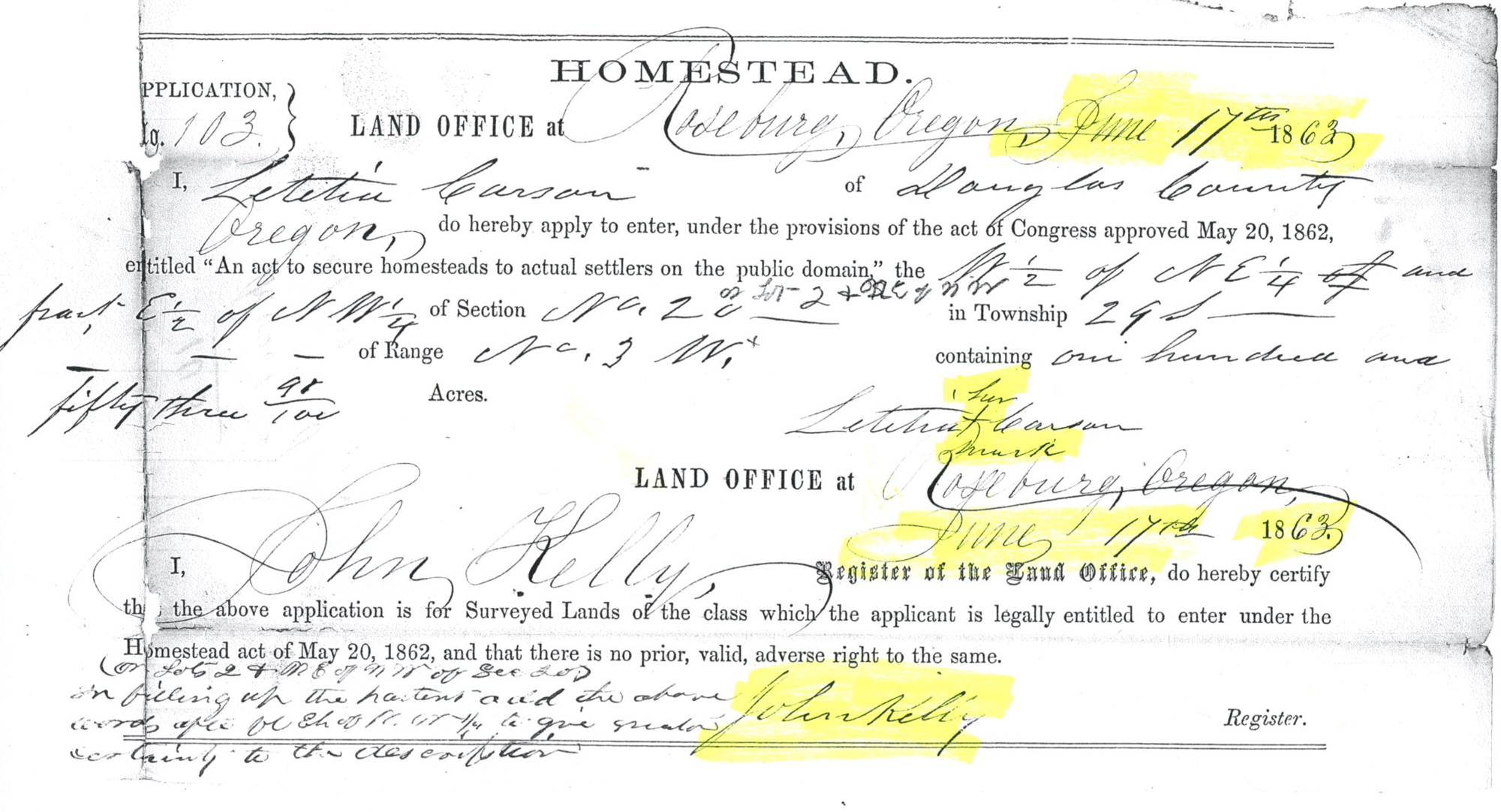
"This document is an application filed by Letitia Carson on June 17th, 1863, as she settled on land in Douglas County as part of the Homestead Act of 1862. With this application, she agreed to stay on this land, cultivating and improving it for five years. The document includes the coordinates and other information on the land, as well as signatures from both Letitia and John Kelly, Register of the Land Office in Roseburg."
- Letitia Carson Digital History Collection

This exhibition was created by Oregon Black Pioneers. The rental of it by BCHS is partially sponsored by the Oregon State University Center for Small Farms and Sustainable Food Systems.
"Oregon Black Pioneers is Oregon’s only historical society dedicated to preserving and presenting the experiences of African Americans statewide. For more than 30 years, we’ve illuminated the seldom-told stories of people of African descent in Oregon through our engaging exhibits, public programs, publications, and historical research. Additionally, we partner with local organizations to identify, interpret, and preserve sites with African American historical significance.
Our Mission is to research, recognize, and commemorate the history and heritage of African Americans in Oregon."